
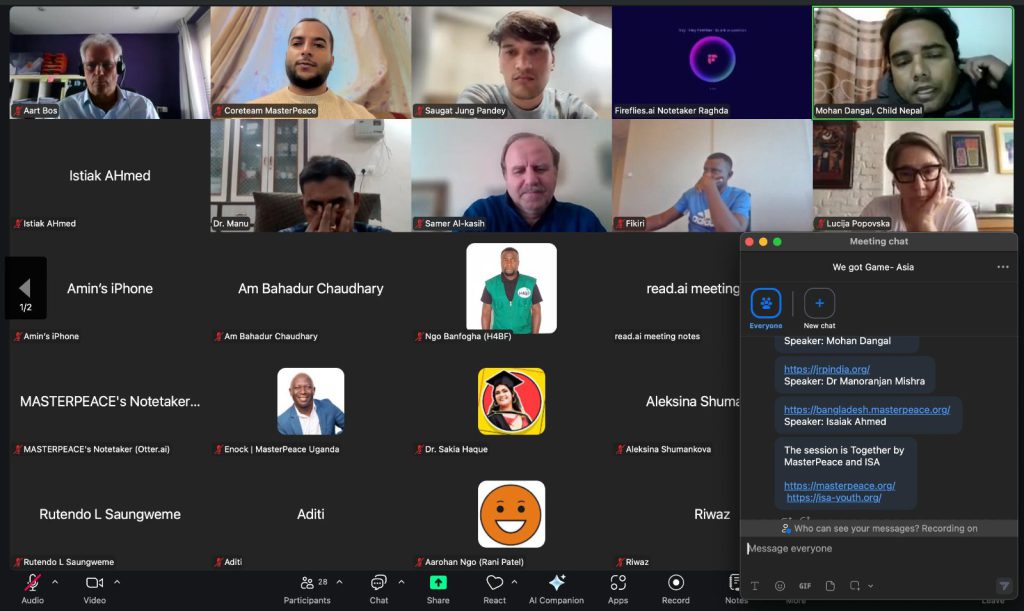
On Friday, 23 January 2026, voices from across South Asia came together online for “We Got Game Asia,” a webinar exploring how sports can be used as a powerful tool for social change. The session was part of the Learning Planning Festival organized by the Learning Planet Institute (LPI), celebrated every year on the International Day of Education in collaboration with UNESCO.
Set in a South Asian context, the webinar focused on how sports go far beyond physical activity, becoming a means to build communities, challenge inequalities, promote peace, and create opportunities for young people. The session brought together practitioners who have spent years using sports on the ground in Bangladesh, India, and Nepal.
Setting the Stage: Sports, Education, and Social Impact
The webinar opened with reflections on the Learning Planet Festival and its focus on innovation in education. Aart Bos, Strategic Business Developer at ISA, started the session by sharing how sports have shaped his own life , from building friendships to creating bridges across divided communities. Drawing from his experience in contexts like Burundi, he highlighted how sports can connect people where words and policies often fall short.
Saugat Jung Pandey, Project Officer at MasterPeace, moderated the session and framed the discussion. He invited participants to look at sports not only as games, but as spaces where values like teamwork, inclusion, leadership, and resilience are learned naturally.
Voices from South Asia: Sports in Action
From Nepal, Mr. Mohan Dangal, Executive Director of Child Nepal (CN), shared how football has been used as a tool for early childhood development and girls’ empowerment. Through collaborations with partners such as the FIFA Foundation and the European Union, Child Nepal has i
ntegrated football into learning spaces to help children build confidence, communication skills, and social awareness. Mohan emphasized how sports have helped shift parental attitudes especially towards girls, by showing thatplay can be educational, safe, and empowering.
From Bangladesh, Mr. Istiak Ahmed, Founder of SARCC and MasterPeace Bangladesh, reflected on the shrinking access to playgrounds and outdoor activities, especially in urban areas. He spoke about how the lack of safe spaces for play can contribute to isolation and negative influences among young people. At the same time, he highlighted encouraging developments, such as the rise of women’s football in Bangladesh, now recognized at the national level. Istiak also stressed the importance of preserving local and traditional games, which are deeply tied to culture, identity, and community bonding.
From India, Dr. Manoranjan Mishra, Director of Jeevan Rekha Parishad (JRP), shared deeply personal and community-level experiences. He spoke about how sports supported his own recovery after injury and COVID-19, and how JRP uses sports, including archery, w
restling, and indigenous games, to transform youth lifestyles in Odisha. His work focuses strongly on tribal communities, underprivileged youth, and girls, creating safe spaces where sports help break caste, gender, and religious barriers.
Sports as a Bridge for Inclusion and Peace
Several stories shared during the discussion illustrated how sports can bring divided communities together. Dr. Mishra described how sports activities helped integrate Dalit and general caste children around Chilka Lagoon, improving school attendance and community relations.In another case, football matches helped rebuild trust between Hindu and Christian communities in Kandhamal after ethnic violence.
Participants from other regions, including Samer
Alkasih from MasterPeace Jordan, also shared how sports support mental health, refugee integration, and youth engagement, reinforcing that while contexts differ, th
e impact of sports remains universal.
Challenges, Opportunities, and the Way Forward
The speakers did not shy away from challenges. Limited infrastructure, lack of trained teachers, inconsistent institutional support, and governance issues were openly discussed. Yet, there was strong agreement that impact does not always depend on big budgets, but on mindset, collaboration, and commitment.
The session concluded with reflections on the growing relevance of sports as non-formal education, especially in preparing young peoplefor life and work. Participants explored opportunities for cross-border collaboration, knowledge sharing, and capacity building, including the idea of an online workshop to exchange sports-based methodologies.
From Conversation to Action
As a concrete next step, speakers agreed to continue the dialogue beyond the webinar. Plans included exploring partnerships with schools, organizing follow-up meetings, and sharing practical tools and methodologies across the region. We Got Game Asia was more than a webinar. It was a reminder that sports can be a language of hope one that speaks across borders, cultures, and identities. By placing young people, inclusion, and community at the center, the session showed how something as simple as a game can become a powerful force for education, empowerment, and social change.